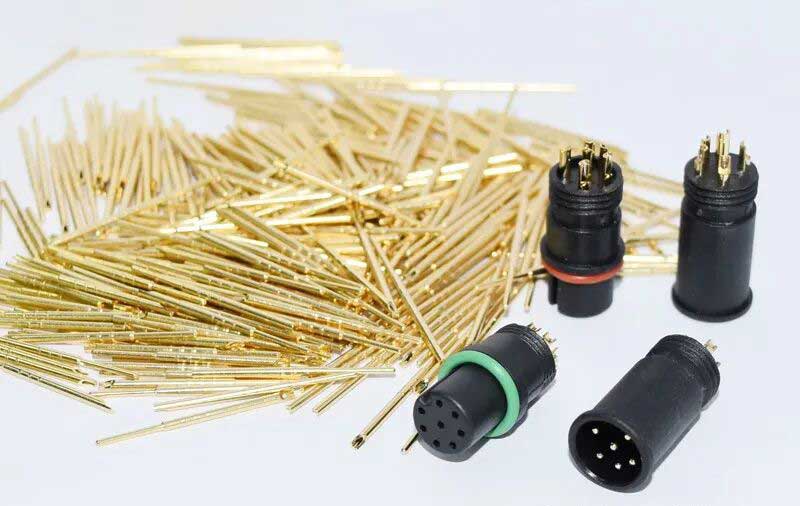
There are numerous manufacturers of M-series connectors,and buyers naturally seek products that offer good value for money.So,how can you make a preliminary assessment of a connector's quality at the initial selection stage?Here is a brief guide on how to distinguish between products of varying quality.
I.Material Selection:
The conductive components of the connector are primarily the male and female terminals.Terminals should be made of brass with high electrical conductivity and feature a nickel-under-gold plating to enhance conductivity and corrosion resistance.The gold plating thickness and the specific copper alloy chosen directly impact durability and solderability.To facilitate usage and soldering,M-series male terminals are typically made of CuZn(brass),while female terminals use CuSn(phosphor bronze);the difference in material stems from the fact that female terminals are hollow and require greater hardness.
Regarding the plastic insert(housing),nylon is the standard material due to manufacturing feasibility and thermoplastic properties.Shengena utilizes PA66 nylon made from imported virgin resin—avoiding the use of regrind(recycled scrap)—to ensure a superior aesthetic finish.
Housing materials are selected based on CNC machining or die-casting requirements;typically,brass with plating is used.
II.Structural Design:
Structural design affects product assembly and usage,as well as visual appeal.Products should feature a glossy finish and a streamlined profile.Customization options,such as adding a logo label,are available;for such needs,collaborating with a manufacturer that has professional R&D capabilities is recommended.Shengena connectors are manufactured in accordance with IEC standards,ensuring both aesthetic quality and reliability.
III.Durability and Environmental Performance:
Durability encompasses factors such as mating cycles,impact resistance,vibration and damage resistance,and drop resistance.When selecting a connector,one should consider specifications regarding mating cycles,flex/swing tests,drop tests,and vibration test ratings.Environmental considerations include temperature extremes(high and low),humidity,saline/alkaline environments,corrosive gases,and water exposure.Selection should be based on verifying specifications such as operating temperature range,waterproof rating,and salt spray test duration.Regarding temperature,the connector industry standardizes the operating range at-40°C to 85°C based on technical constraints:at temperatures below-40°C,the plastic components may crack and damage the connector;at temperatures above 85°C,the 30°C rise in operating temperature causes ionization of the metal terminals,leading to reduced activity,degraded electrical performance,and increased impedance.If high-temperature-resistant connectors are required,you must request a custom solution from the manufacturer.Salt spray resistance must also be verified;standard specifications are 48 hours for gold-plated brass components and 24 hours for nickel-plated brass components.You should confirm whether these ratings meet the requirements of your specific operating environment.
IV.Manufacturer Website and Relevant Certifications:
While the previous point focused on evaluating the product itself,this section focuses on assessing the company's capabilities via its website and the credibility of its products through certifications.Generally,a reputable manufacturer produces higher-quality products.You should make your selection based on a comprehensive assessment of the price-to-performance ratio.