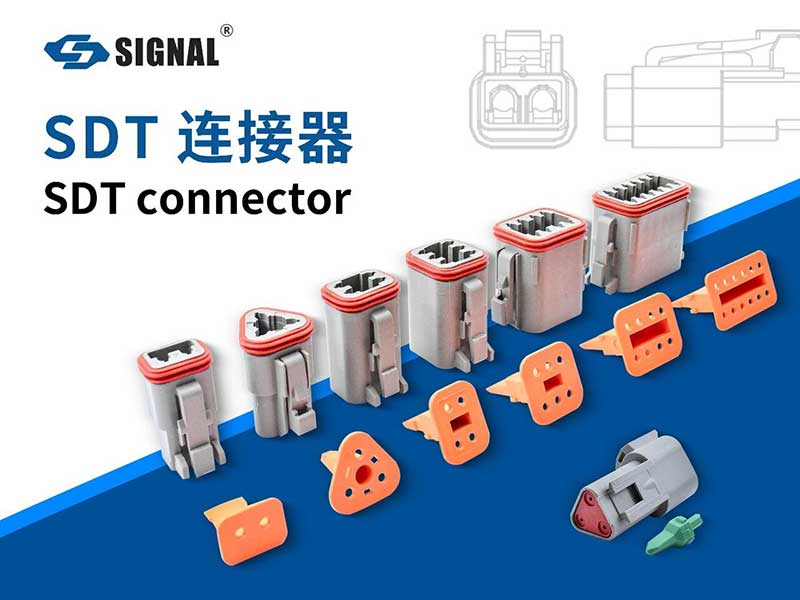
There is a type of connector that has become the standard for demanding industrial environments, thanks to its exceptional ruggedness, complete hermetic sealing, and resistance to both vibration and aging—the SDT connector.
I. Advantages of SIGNAL SDT Connectors
In sectors such as construction and agricultural machinery, where operating conditions are complex and highly variable, the advantages of SDT connectors are amplified—which is precisely why they have become so widely adopted:
1. High Flame Retardancy and Chemical Resistance: Constructed from TPU material, SIGNAL SDT connectors offer excellent flame retardancy and resist corrosion from common oils, acids, and alkalis, thereby extending their service life in harsh environments.
2. Superior Sealing: Featuring a dual-layer sealing design, SIGNAL SDT connectors achieve an IP67 ingress protection rating, effectively blocking out moisture, dust, and contaminants.
3. Stable Operation Across a Wide Temperature Range: With an operating temperature range of -55°C to +85°C, these connectors remain unaffected by extreme temperature fluctuations, ensuring that equipment can start, stop, and operate reliably in both freezing cold and high-heat environments.
4. Flexible Configuration and Intelligent Expansion: Available in 2- to 12-pin configurations with customizable cable harness lengths, they are capable of transmitting both power and bus signals.
II. Application Areas for SIGNAL SDT Connectors
SIGNAL SDT connectors are primarily used in the following fields:
1. Construction Machinery
Construction machinery represents one of the primary domains for the deployment of SDT connectors. Used in excavators, loaders, cranes, mining equipment, forklifts, and similar machinery. Designed to withstand harsh operating conditions—such as those found in mines, agricultural fields, and ports—characterized by high levels of vibration, dust, and exposure to water. Facilitates the connection between sensors, controllers, and actuators.
2. Agricultural Machinery
Used in tractors, combine harvesters, and smart agricultural equipment; supports high-speed data connectivity and remote monitoring.
3. Automotive
Used in automotive electronic systems (such as in-vehicle infotainment, ADAS/autonomous driving modules, battery management systems (BMS), motor controllers, and sensors) as well as vehicle CAN bus communication. Suitable for high-temperature, high-vibration environments, including areas under the hood and within the chassis.
4. New Energy
Used in inverters, energy storage battery management systems (BMS), and EV charging connectors. Designed for complex outdoor environments, ensuring stable connections for high-voltage power supply, CAN communication, and temperature/voltage sensing.
5. Industrial Automation
Used in PLCs, industrial robots, servo drives, smart meters, power generation equipment, and railway signaling systems. Provides reliable connectivity for industrial sensor clusters, machine-to-machine (M2M) communication, and the transmission of power-related data.