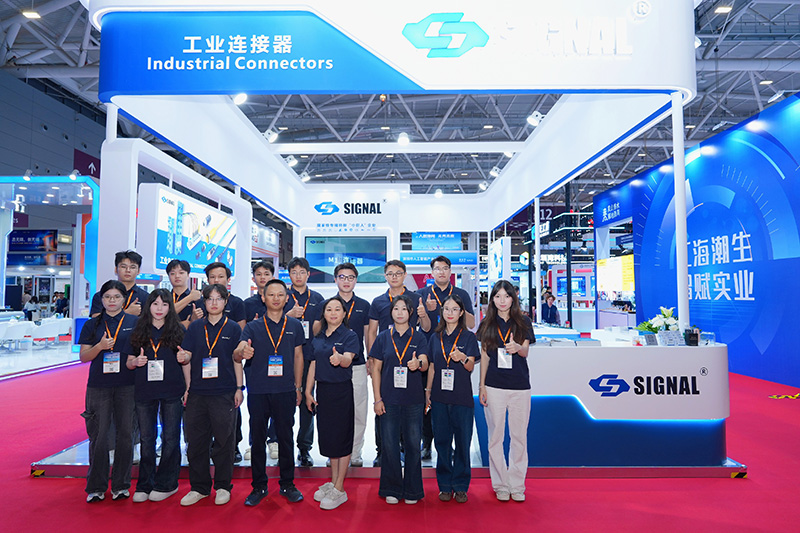
The three-day 2026 AGIC Shenzhen International General Artificial Intelligence Expo and GERX Global Embodied AI Robot Industry Expo recently concluded successfully at the Shenzhen World Exhibition & Convention Center. Centered on the theme "Human-Machine Collaboration: A Boundless Future," the event focused on cutting-edge sectors such as embodied AI, industrial AI sensing, IoT technology, and smart automotive electronics. It brought together over a thousand industry leaders and premium global procurement resources, showcasing a new industrial landscape defined by the practical application of AI and domestic innovation.
As a national-level "Little Giant" enterprise (recognized for specialization, refinement, uniqueness, and innovation), Shenzhen Signal Electronics Co., Ltd. (Signal) participated in the AGIC event for the third consecutive year. At this expo, the company launched a comprehensive interconnect solution for embodied AI robots, featuring a full suite of domestically produced products—including M-series circular waterproof connectors, IO-Link bus systems, machine vision components, and specialized automotive wiring harnesses. These exhibits demonstrated the company's deep technical expertise and innovative capabilities in the field of foundational connectivity for intelligent equipment.
Throughout the expo, Signal technical and marketing teams engaged deeply with R&D, procurement, and engineering teams from across the supply chain—spanning embodied AI robotics, machine vision, automotive electronics, and industrial automation. Addressing core industry challenges such as connectivity under dynamic operating conditions, lossless high-speed signal transmission, and adaptability to complex environments, the company provided highly reliable, domestically produced, and customized interconnect system solutions based on real-world application scenarios, earning high praise from visiting clients and partners.
Focusing on four core sectors to solidify the hardware connectivity foundation for intelligent equipment.
I. Full-Stack Interconnect Solutions for Embodied AI Robots.

For various types of embodied AI equipment—such as humanoid robots, quadrupedal robot dogs, and industrial wheeled-arm robots—Signal has developed a one-stop "robot nervous system" interconnect solution. This solution covers the entire signal chain, spanning head-mounted visual perception, torso main control systems, joint power transmission, and tactile signal acquisition for dexterous hands.
The solution features specialized high-flexibility composite cable harnesses for joints, miniature high-speed signal connectors, and integrated power-and-signal interconnect assemblies. These products are engineered to withstand the rigorous operating conditions faced by robot joints, including repeated twisting, high-frequency bending, and continuous vibration. Designed for miniaturization, lightweight construction, and long service life, they ensure stable power and high-speed data communication between perception, computing, and actuation units. They meet requirements across all stages—from prototype development and small-batch pilot runs to mass production—and serve as the implementation vehicle for core technologies defined in the *Technical Specification Standards for Embodied AI Robot Cable Harnesses*.
II. Deep Expertise in Machine Vision: Securing Lossless Transmission Links for High-Definition Imaging

Industrial production environments are rife with complex electromagnetic interference, which can easily cause image distortion and inspection errors, thereby compromising the accuracy of visual inspection systems.
To address these industry pain points, Signal specialized connectors for industrial cameras and high-shielding vision cable harnesses utilize proprietary anti-interference shielding structures. These designs effectively mitigate electromagnetic crosstalk, ensuring the real-time, lossless, and zero-latency transmission of high-definition images and inspection data. With industrial-grade attributes such as resistance to bending and oil contamination, as well as long service life, these products are widely used in applications like precision 3C inspection, intelligent sorting, and surface defect detection, continuously reinforcing the hardware foundation for high-speed data transmission in the machine vision industry.
III. Empowering Automotive Intelligence and Accelerating the Localization of Automotive Electronics
The intelligent upgrading of traditional production lines often faces challenges such as complex wiring, poor equipment coordination, cumbersome O&M (operations and maintenance), and inadequate adaptability to operating conditions.
Signal integrates three core capabilities—waterproof connectivity, intelligent bus systems, and custom wire harnesses—to deliver a one-stop industrial interconnection solution. This solution covers the entire process, from sensor data acquisition on the production line to equipment coordination and intelligent data transmission. Featuring strong compatibility, easy installation, and simple maintenance, the products effectively reduce costs associated with production line retrofitting and O&M. They facilitate the intelligent evolution of traditional industrial control equipment, ensuring the efficient, stable, and continuous operation of smart manufacturing lines.
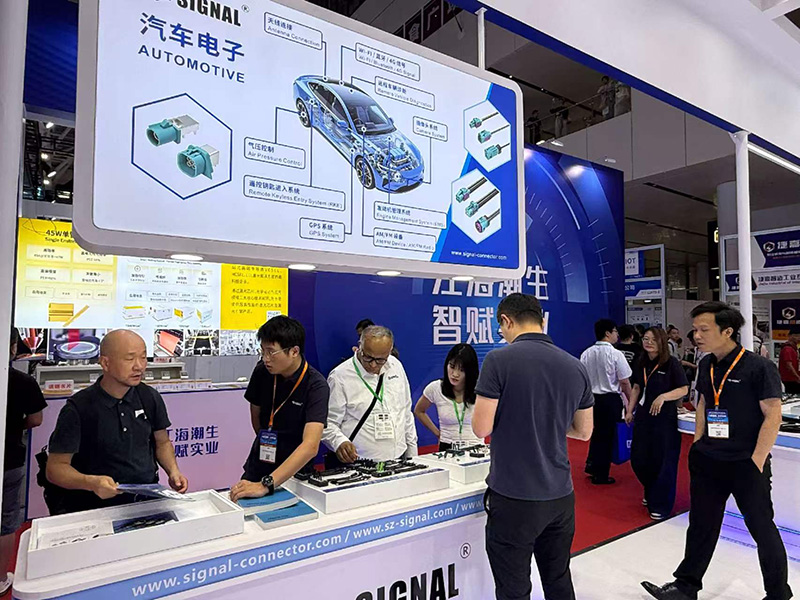
With the rapid evolution of intelligent driving and in-vehicle sensing technologies, equipment such as millimeter-wave radars, automotive imaging systems, and vehicle communication modules demands increasingly higher standards for signal transmission stability, low signal attenuation, and resistance to environmental interference.
The automotive coaxial connectors and specialized wire harness assemblies showcased by Signal strictly adhere to automotive industry reliability standards. They offer superior shielding, low signal loss, resistance to extreme temperatures, and high vibration resistance. These products effectively resolve issues like signal distortion and transmission lag in complex automotive environments, fully meeting the needs of high-speed in-vehicle data transmission and providing highly reliable, localized interconnection support for the new energy vehicle and intelligent driving industry chains.
Interviewed by Shenzhen TV | Decoding the "Neural Pathways" of the Embodied AI Industry
During the exhibition, Wang Hua, Deputy General Manager of Signal, was invited to participate in a special "Face-to-Face with Leading Enterprises" interview with Shenzhen TV. Speaking from an industry insider's perspective, he provided an in-depth analysis of the industrial value of underlying hardware for intelligent equipment and the trends driving its localization. Founded in 2009, Shenzhen Signal Electronics has long been deeply engaged in the field of industrial-grade high-speed interconnects. The company specializes in providing high-speed signal transmission and robotic neural network connectivity solutions to leading enterprises in sectors such as international industrial vision, domestic LiDAR, collaborative robotics, and intelligent automotive systems. In 2025, Signal spearheaded a collaborative effort with over twenty leading robotics companies and institutions—including Agibot, Pudu Robotics, LimX Dynamics, Googol Servo, Huacheng Industrial Control, Uditech, Yizhao, Guangdong Huayan Robotics, Meilimofang Robotics, Zhihui Technology, China Unicom Shenzhen, and the Guangdong Future Industry Research Institute—to formulate the *Technical Specifications and Standards for Wiring Harnesses in Embodied AI Robots*. This initiative fills a gap in industry standards and drives the standardized development of the embodied AI industry.
In an interview, Wang Hua noted that while AI algorithms serve as the robot's "brain," connectors and wiring harnesses act as its "nervous system."
The entire process—from sensor perception and data processing to physical execution—relies on hardware transmission links that are stable, lossless, and fatigue-resistant. Reliable underlying connectivity is essential to enable humanoid robots and industrial intelligent agents to perform precise, flexible, and continuous intelligent operations; thus, these components serve as indispensable core foundations for the industrialization of embodied AI. Amid the wave of comprehensive localization for AI equipment, end-user devices are demanding increasingly sophisticated hardware capabilities regarding dynamic fatigue resistance, high-speed interference immunity, and adaptability to complex operating conditions. Wang Hua stated that Signal remains guided by real-world end-user operating conditions, continuously iterating its localized interconnect products and customized solutions. By focusing on four core sectors—embodied AI robotics, machine vision, intelligent driving, and industrial automation—the company precisely addresses connectivity pain points, thereby supporting the autonomous, controllable, and high-quality development of the domestic AI intelligent equipment supply chain. Unwavering in its commitment to innovation, the company continues to empower the high-quality development of the industry.
At AGIC, Signal leveraged its newly launched full-stack interconnectivity solutions for embodied AI robots—backed by a mature product portfolio, solid technical expertise, and professional service capabilities—to deeply integrate upstream and downstream resources, capture genuine market demands, and secure multiple partnership leads. These efforts have further strengthened the company's industry influence in the field of underlying interconnectivity for intelligent equipment.
Looking ahead, Signal Electronics will remain focused on three core capabilities: R&D innovation, large-scale delivery, and standardized quality control. The company will continue to refine its localized, highly reliable, and customized industrial interconnectivity solutions, deepening its presence in the hardware infrastructure sector for intelligent equipment. By doing so, it will continue to drive industrial upgrades across the embodied AI, industrial automation, and intelligent automotive supply chains, ultimately supporting the high-quality, standardized, and large-scale development of China's intelligent manufacturing industry.