As critical components for interconnecting two printed circuit boards (PCBs), various types of board-to-board connectors are designed to meet diverse structural and performance requirements, finding widespread application across a wide range of electronic products. But do you know just how many different types of board-to-board connectors exist?
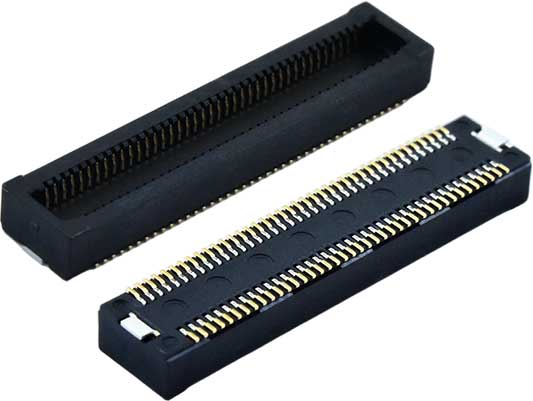
I. Definition of Board-to-Board Connectors
A board-to-board connector is an electrical interface component specifically designed to interconnect two circuit boards. These connectors are characterized by their reliable connectivity, stable electrical performance, and ease of installation. Fundamentally, they facilitate both the mechanical fixation and the transmission of electrical signals between boards through the mating of two primary components: a plug and a receptacle.
II. Types of Board-to-Board Connectors
Vertical Connectors:As the name implies, the plug is inserted vertically into the receptacle, resulting in a connection orientation that is perpendicular to the surface of the circuit board. These are suitable for applications where space is limited and where quick plug-and-unplug capabilities are required.
1. Right-Angle Connectors
The connection direction between the plug and the receptacle forms a 90-degree angle. These are suitable for designs where PCB routing space is restricted and a horizontal connection orientation is required.
2. Mezzanine Connectors (Blind-Mating Connectors)
Also known as board-stacking connectors, these allow two circuit boards to be stacked in parallel, utilizing the connector to establish a direct, high-density vertical interconnection. They are widely employed in modular design architectures.
3. Press-Fit Connectors
These connectors utilize press-fit technology—rather than soldering—to establish a mechanical and physical connection with the PCB. They are well-suited for applications demanding high reliability as well as those operating in high-temperature environments.
4. Pin-and-Socket Connectors
Representing a traditional form of connector, these utilize a mating system of pins and sockets. Characterized by their simple structure and low cost, they are suitable for connecting low-speed and low-frequency signals.
5. Spring-Pin Connectors
These connectors utilize spring-loaded pins to establish a connection, offering excellent contact pressure and resilience. They are well-suited for environments subject to vibration and for applications requiring frequent mating and unmating.
III. Common Application Scenarios
1. Communication Equipment
In devices such as network switches and base stations, high-density blind-mate connectors are employed to ensure high-speed signal transmission and facilitate modular expansion.
2. Consumer Electronics
In devices such as smartphones, tablets, and laptops, blind-mate and direct-insertion connectors are used to interconnect the mainboard with display modules, batteries, or camera modules.
3. Medical Equipment
Medical monitoring instruments require highly reliable connections and stable signal transmission; consequently, spring-pin and press-fit connectors are widely utilized in this field.
4. Industrial Automation
In industrial control equipment, press-fit and spring-pin connectors are adopted to ensure stable signal transmission, offering robust adaptability to environments characterized by vibration and high temperatures.
5. Automotive Electronics
In systems such as in-vehicle infotainment units and engine control units, board-to-board connectors must demonstrate high reliability and thermal resistance; press-fit connectors are frequently used for these applications.