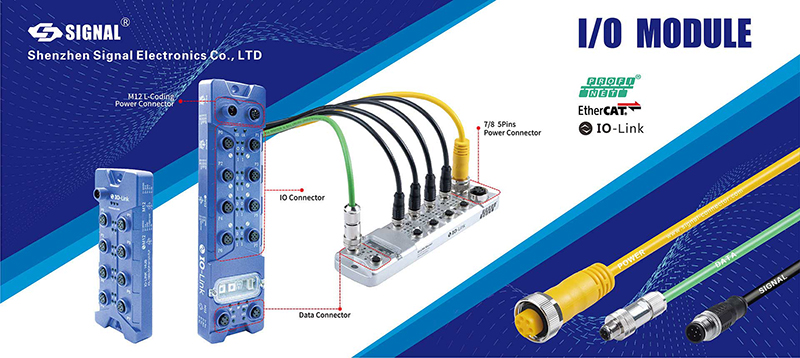
Amid the wave of intelligent manufacturing, every technological innovation carries the vital responsibility of driving industry progress. As a key innovation in the field of industrial automation, IO-Link technology—with its unique advantages—is shaping the future of smart factories.
I. What is IO-Link?
IO-Link (short for "Input/Output Link") is not a fieldbus, but rather an open standard for serial communication (IEC 61131-9). It breaks down the information barriers between traditional sensors and control systems, enabling bidirectional communication and data exchange between devices—a development that has brought a revolutionary shift to industrial automation.
II. What are the advantages of IO-Link?
1. Simplified wiring: IO-Link streamlines circuit connections by requiring only a single standard cable, which significantly reduces the complexity of wiring layouts.
2. Enhanced operational convenience: With IO-Link, systems support remote configuration, eliminating the need for physical, on-site configuration buttons on devices.
3. Strong interference resistance: Unlike traditional data transmission, which often relies on analog signals between sensors and controllers, IO-Link utilizes fully digital communication, resulting in superior resistance to interference.
4. Easy replacement: IO-Link enables automatic parameter configuration; when a sensor or actuator is replaced with an identical unit, the system automatically transfers the existing configuration parameters to the new device. 5. No Signal Loss: Traditional data transmission processes often require digital-to-analog and analog-to-digital conversions. In contrast, IO-Link utilizes fully digital transmission; since no data-type conversion occurs, there is no loss of precision.
6. Intelligent Devices: By incorporating IO-Link technology, sensors can transmit multiple signals simultaneously, unlocking their full potential. This makes devices more intelligent and simplifies both wiring and operational tasks.
7. Wire-Break Monitoring: IO-Link enables two-way communication within digital point-to-point connections, providing the system with enhanced data-exchange capabilities. This facilitates system diagnostics, allowing for alarms to be triggered in the event of a wire break.
III. What Are the Application Scenarios for IO-Link?
1. Oil and Gas Exploration
IO-Link connects sensors and actuators used in exploration instruments and equipment, enabling real-time data transmission and control. It facilitates the integration and unified management of equipment, thereby improving both efficiency and safety in exploration operations.
2. Medical Equipment
IO-Link connects various medical sensors, allowing for the real-time monitoring and recording of a patient’s vital signs. It streamlines connections and communication between devices, enhancing the overall performance and reliability of the system.
3. Factory Automation
IO-Link enables two-way data exchange between sensors/actuators and a master unit. It provides detailed diagnostic information, helping engineers quickly locate and resolve equipment faults.
4. Marine and Offshore Engineering
IO-Link enables the interconnection and interoperability of equipment, ensuring stable and reliable data transmission even in complex marine environments.
5. Rail Transit
Connects various signaling equipment and sensors to enable real-time monitoring and control of train operating status.